AI in Food and Beverage Manufacturing

Used in the right order, AI helps a plant catch losses earlier, hold quality steadier, and act on problems as they happen instead of after the shift. The payoff depends on a trusted production record for the AI to work from. That record is what DFX, an AI-native MES, is built to create as the line runs.

Agentic AI acts across the line on one shared record

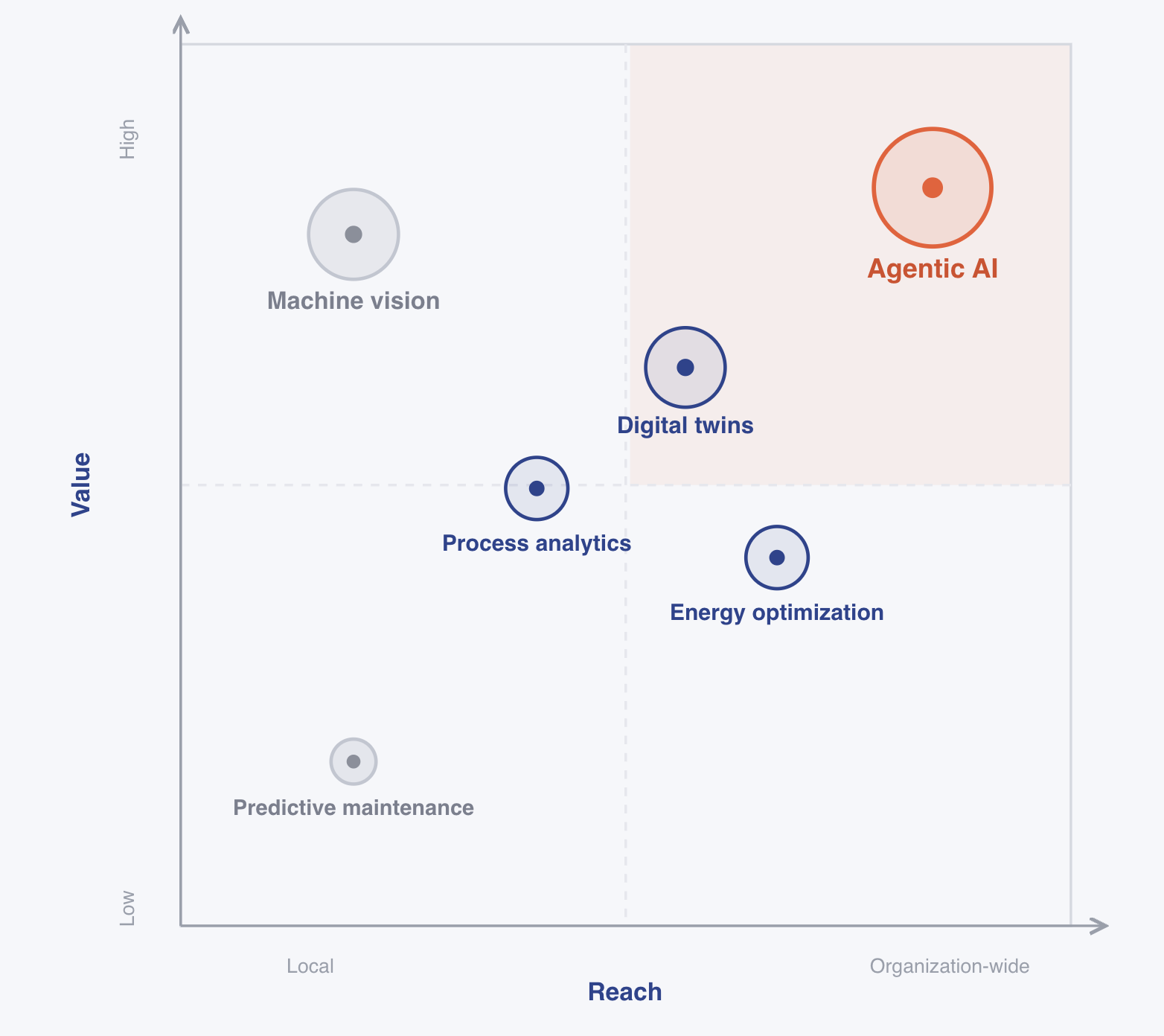
The AI worth the investment does two things at once: creates real value and reaches across the whole operation. That is why agentic AI, acting on one shared record, pays off where single-point tools cannot.

Level 1

Point tools

A machine vision system inspects dimensions, labels, seals, or foreign objects and rejects the units that fail. Valuable for quality, but single-purpose: it improves one inspection point.


Predictive maintenance reads sensor data, often vibration, to flag a machine before it fails. The payback is real but narrow: a few critical assets, not every machine, and it is oversold as the place to start. It works best on a trusted production record, where it shifts maintenance from calendar-based to condition-based.

Level 2

Analyzing patterns

Process analytics reads live process data to find where quality drifts or yield slips. The value pays off on the few steps with variable chemistry, such as cooking and pasteurizing, and adds little where the process is stable (blending) or biological (fermentation). Much of the plant is mechanical, like filling and packing, with nothing to tune. Point it at the chemistry, not the whole line.


Energy optimization is similar and just as local. The biggest users, refrigeration, compressed air, and heating, are already known and predictable, so there is little to uncover. It pays off most when consumption is read against the production record, indexed to units produced.

Level 3

Models of the system

A digital twin is a virtual model of a machine or line that stays in sync with the real thing through live data. Its job is to mirror the equipment now and surface drift early, before it becomes scrap or a stop.


The value is real but overstated. The full simulation promise, testing a change before you run the batch, rarely holds: many SKUs and product mixes make the line hard to model. A twin is best used to watch and anticipate, and it gives agents a foundation to act on.

Level 4

Autonomous agents

Autonomous agents model how an experienced person would act on the data in front of them. Built on large language models, they hold context, reason through messy data, and handle situations no one wrote a rule for, working across the whole line rather than one point.

An agent can sequence the next run, work out why a line slowed, or recommend holding or releasing a batch, while people keep the judgment calls. Value and reach meet here, so the payoff is the broadest of the four. But agents only work on a record they can trust, which is why DFX, the AI-native MES , runs them on the live production record it captures as the line runs.

Introducing AI into a food and beverage plant

AI pays off in a specific order. First, the plant floor becomes one reliable record. Then AI is layered on by payoff, from local tools to agents that work across the whole line.

1
Connect the machines

Network the equipment and integrate the OT and IT sides. A unified namespace gives every machine and system one common way to publish its data.

2
Digitize the human inputs

Machine signals are only half the picture. Capture quality checks, maintenance checks, and operator observations digitally.

3
Deploy a scalable system of record

Machine and human data have to exist in one central record that scales across lines and plants, not local systems tied to a single line or site. This is the MES layer, and an AI-native MES like DFX is built to be that record from day one, so the AI you add later has a trusted foundation to act on.

4
Add in-line AI systems

Add line-level systems for specific quality issues such as fill, seal, label, and foreign-object detection. Choose ones that connect and share data rather than sit in a silo.

5
Model the lines with digital twins

Use digital twins to mirror the lines and surface drift on the steps with a real, continuous process such as thermal and mixing stages. Treat a twin as a way to watch and anticipate, not to run full simulations.

6
Deploy agentic systems

Deploy agents to support teams on day-to-day decisions, reasoning through complex, changing situations rather than routine tasks. People still make the judgment calls, with agents doing the legwork and surfacing the options, all on the same production record the earlier steps put in place.

AI that accounts for what a food and beverage line demands

Batch and recipe production
Production is batch and recipe driven, so every reading, stop, and check has to trace back to a batch. AI here works at the batch level.
A constant product mix
One line runs many SKUs, each with its own speed, recipe, and limits, and the changeovers are constant. Anything that models the line has to account for the mix.
Variable inputs

Ingredients are natural and vary from lot to lot, so the same recipe can behave differently from one batch to the next. There is no fixed normal to model against, and the AI has to keep up with conditions that change on their own.

Compliance and traceability
Allergens, holds, and audits mean a release or reject call has to be recorded with its reasons. That makes the record a compliance requirement.

DFX, an AI-native MES, turns the production record into measurable gains in quality, productivity, and sustainability in food and beverage plants.

Proven across live food and beverage deployments

200+

lines connected

8%

average OEE improvement

170+

plants live

XXM+

cases traced annually

Case study snapshot

Pernod Ricard: Scaling operational intelligence across 30 facilities

Pernod Ricard: Scaling operational intelligence across 30 facilities

Altizon’s DFX Platform unified Pernod Ricard’s production, quality, and sustainability data by replacing fragmented, paper-based…

Large Beverages Major: Standardizing performance across multi-OEM bottling lines

Large Beverages Major: Standardizing performance across multi-OEM bottling lines

Altizon’s DFX Platform helped large beverages major connect multi-OEM bottling lines and utilities into a…

Frequently asked questions (FAQs)

It is software that reads what is happening in production and helps decide what to do about it. It takes a few forms: machine vision, process analytics, digital twins, predictive maintenance, and agentic AI. They are not equal in value. Most act on one point of the line, while agentic AI works across the operation on one shared record.
It comes down to two things: how much value a use case creates and how far it reaches across the operation. Agentic AI scores on both because it makes the daily decisions that run the plant on one record. Process analytics and digital twins pay off in the specific places where there is a real process to work with. Machine vision is valuable but local. Predictive maintenance is real but narrow.
Yes, on the right assets. It reads sensor and equipment data to flag a failure before it happens, and the payback is real on a small set of critical machines. It is oversold when it is treated as the whole AI program, applied to every asset, or started before there is good data to train on. It works best on a trusted production record, which is why DFX runs it as one model on the record rather than a standalone bolt-on.
It is closer to automation than to AI. A camera checks dimensions, labels, seals, or foreign objects and rejects the units that fail. This is proven and valuable for quality, but vision systems have done it for years. It becomes more than automation when it learns a new defect on its own, and when its results feed into one record you can analyze by line, SKU, or shift.
Only in specific places. It earns its keep on the few steps with real, variable chemistry, such as cooking and pasteurizing. It adds little where the process is stable, such as blending or biological processes such as fermentation, and nothing on mechanical stages like filling and packing. The value comes from pointing it at the steps with chemistry, not across the whole line.
A digital twin mirrors a machine or line from live data, so it shows the current state and surfaces drift early. Testing a new setting on the model before you run the batch is not realistic on most food and beverage lines, because the SKU count and natural variation make the model hard to sustain. A twin is best used to watch and anticipate, and it gives agents a foundation to act on.
Agentic AI models how an experienced person would act on the data in front of them. Built on large language models, it holds context, reasons through messy data, and handles situations no one wrote a rule for. On the floor, it can sequence the next run, work out why a line slowed, or recommend holding or releasing a batch, while people keep the final judgment calls. See the AI-native MES for how DFX runs agents on the record.
Yes. With generative AI, someone can ask a question in plain language, such as why line 3 was down last night, and get the answer from the production record instead of building a report. This works only when the answer already sits in one reliable record. DFX captures that record as the line runs, so the answer reflects what actually happened.
A reliable data foundation. The machines need to be connected and networked, ideally through a unified namespace so every system publishes data the same way. Human inputs, such as quality and maintenance checks, need to be captured digitally, and all of it has to land in one central record that scales across lines and plants. AI added before this foundation exists tends to disappoint because it has nothing solid to work from.
Most fail because the data was never built for it. When AI is added on top of data copied out of separate systems, it inherits the gaps in that data and cannot be trusted on the floor. This is why AI in manufacturing depends on the record an MES creates: one reconciled account of production, downtime, and quality, tied to the batch. DFX is an AI-native MES, so it is the record captured as the line runs, and the same system the AI acts on.

Let’s put AI where the decisions are.

We will connect a line, build the record from your machines, and show you the daily decisions AI can take on it.